

Best Coffee for Home Brewing Ritual: A 2026 Guide
Last Updated: October 23, 2026
Quick Summary
The best coffee for home brewing starts with freshly roasted whole beans, not equipment, because the bean sets the ceiling on your cup. Match the roast to your method and start at a 1:16 coffee-to-water ratio, then adjust one variable at a time by taste.
- Buy whole beans with a visible roast date and grind just before brewing.
- Use medium-light to medium roasts for pour-over and drip, and darker roasts for espresso.
- Weigh beans and water with a digital scale instead of scooping.
- Aim for water around 90 to 96 degrees Celsius and use filtered water.
- The Single Origin Favorites Sample Pack holds six 2 oz portions for $24.99.
Table of Contents
- Why the Best Coffee for Home Brewing Starts With the Bean
- Home Coffee Brewing Methods and the Beans That Suit Them
- Coffee Roast Levels for Home Brewing: Match the Roast to Your Method
- Coffee-to-Water Ratio for Home Brewing: A Repeatable Starting Point
- Best Roastica Coffees for Every Home Brewing Ritual
- Freshness, Storage and Buying Quantities for a Better Daily Cup
- A Repeatable Sensory Ritual: Taste, Adjust and Troubleshoot
- Conclusion
- Frequently Asked Questions
Why the Best Coffee for Home Brewing Starts With the Bean
The best coffee for a home brewing ritual starts with freshly roasted whole beans, not equipment. A great grinder cannot rescue stale coffee, and no brewing method fixes a bean roasted months ago.
A modest dripper with excellent whole beans beats a premium setup with tired grounds every time. Below, we show you how to match beans to methods, set a repeatable ratio, and troubleshoot by taste.
If you want to see how origin shapes flavor before buying full bags, browse our single origin coffee range and read the tasting notes on each listing.
Home Coffee Brewing Methods and the Beans That Suit Them
Home coffee brewing methods fall into two families: filter brewing, which uses a paper or reusable filter for a clean cup, and immersion brewing, where grounds steep in water. Espresso sits apart, using pressure to push water through a packed bed of fine grounds.
Pour-Over and Drip: Clean Cups for Bright Beans
Pour-over and drip use a paper filter that traps oils and fine particles, so the cup tastes clean and acidity reads clearly. Medium-light and medium roasts shine here: our Ethiopia Natural with milk chocolate, fruity, caramel notes, or the Tanzania with pear, floral, jasmine, and strawberry. A medium-coarse grind and steady pour keep extraction even.
French Press, AeroPress and Moka Pot: Body and Depth
French press and AeroPress are immersion brewers; the French press uses a metal mesh that lets oils through for a heavier body. Medium and medium-dark roasts hold up well: our Brazil Santos with smooth cocoa notes or the Honduras with caramel, spice, and brown sugar. Use a coarse grind for French press, medium-fine for AeroPress, and medium-fine with darker roasts for the Moka pot.
Espresso: Pressure Needs a Different Bean
Espresso pushes water through a fine grind under pressure, so the bean needs structure. Darker roasts and espresso blends work best: our 6 Bean Blend is a dark roast house blend made for espresso, and African Espresso combines Kenya, Tanzania, and Ethiopia in a medium-dark blend.
If you are still building out your setup, our guide to brewing specialty coffee without equipment covers methods that need very little kit.
Coffee Roast Levels for Home Brewing: Match the Roast to Your Method
Roast level changes what a bean tastes like and how forgiving it is to brew.
| Roast Level | Flavor Character | Best Brew Methods | Roastica Example |
|---|---|---|---|
| Light to medium-light | Fruity, floral, bright acidity | Pour-over, drip | Ethiopia Natural |
| Medium | Balanced sweetness, cocoa, citrus | Drip, AeroPress, pour-over | Brazil Santos, Peru |
| Medium-dark | Caramel, spice, brown sugar | French press, Moka pot | Honduras (sampler) |
| Dark | Cocoa, caramel, bold body | Espresso, French press | 6 Bean Blend |
A common mistake is buying a dark roast for pour-over and wondering why the cup tastes flat and bitter: dark roasts are already developed, so a long filter brew pushes them into bitterness.
For a deeper walkthrough of bean selection, our best coffee beans for home brewing guide expands on roast, origin, and processing.
Coffee-to-Water Ratio for Home Brewing: A Repeatable Starting Point
The coffee-to-water ratio for home brewing is the weight of coffee relative to water, and it makes your results repeatable.
Brew ratio matters more than most people expect.
Water temperature matters too. Aim for water just off the boil, around 90 to 96 degrees Celsius for most methods, and use filtered water. If your tap water tastes of chlorine, your coffee will too.
Best Roastica Coffees for Every Home Brewing Ritual
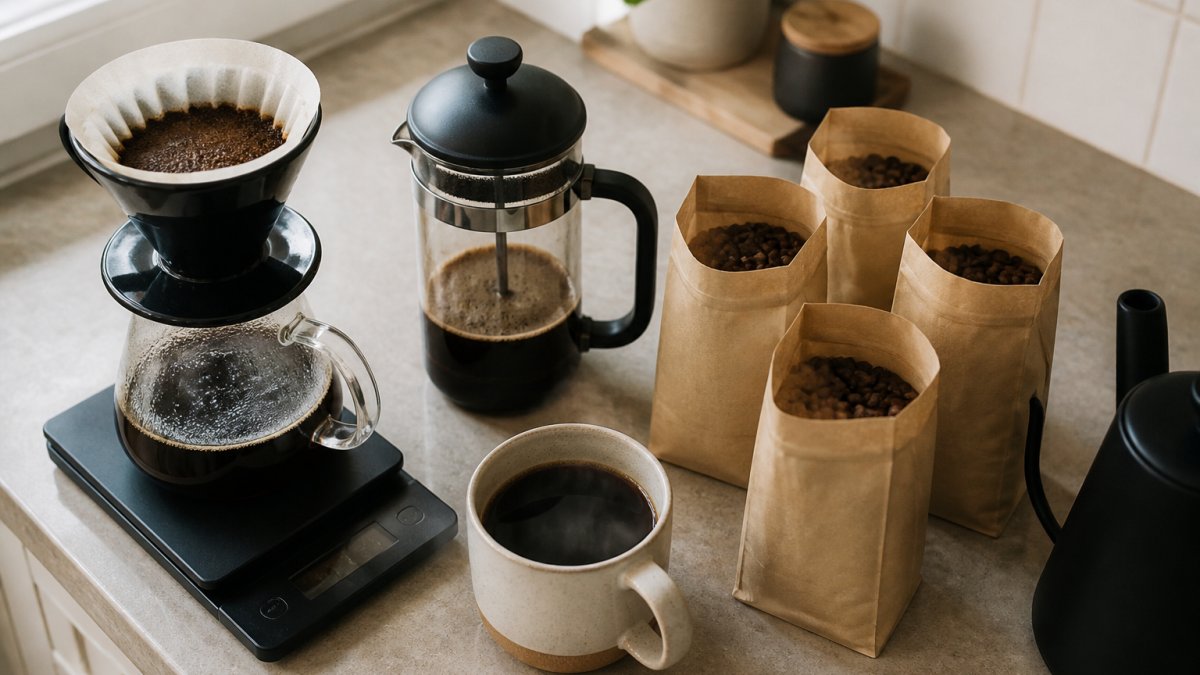
The best coffee for your ritual depends on your brewer, your taste, and how much you want to experiment. Start with what you want from the cup, then narrow by method, caffeine needs, and how often you brew.
Start With Your Taste, Not the Brewer
Use this decision guide to narrow the field:
- You like bright, fruity, tea-like cups: choose light to medium-light roasts and brew them with pour-over or drip. Ethiopia Natural and Tanzania are the clearest examples in our range.
- You like balanced, sweet, everyday cups: choose medium roasts and brew with drip, AeroPress, or pour-over. Brazil Santos, Peru, and Breakfast Blend fit here.
- You like heavy, chocolatey, low-acid cups: choose medium-dark to dark roasts and brew with French press, Moka pot, or espresso. Honduras, 6 Bean Blend, and Cowboy Blend are the natural picks.
Single Origin Favorites Sample Pack: Find Your Flavor Before Committing
The Single Origin Favorites Sample Pack brings six origins in one box: Brazil Santos, Colombia, Costa Rica, Ethiopia, Honduras, and Tanzania. Roasts run from medium-light to medium-dark, so you can taste how origin and roast change the cup. Brew each in your usual method, then buy the full bag that wins. At $24.99, it is the lowest-risk way to find your flavor.
Single Origin Favorites Sample Pack →

Best Sellers Sample Pack: Blends and Origins in One Box
The Best Sellers Sample Pack covers our most popular coffees: 6 Bean Blend, Cowboy Blend, Breakfast Blend, Peru, Mexico, and Bali. It suits anyone comparing blends against single origins across their brewers. The 6 Bean Blend is the espresso pick, Breakfast Blend a smooth medium roast for drip, and Peru brings salted caramel, silky sweet, citrus notes to a pour-over.

Single Origins and Blends for Specific Brewers
Brewer first, bean second, is the simplest way to choose:
- Pour-over or drip: Ethiopia Natural or Peru for bright, clean cups
- French press: Brazil Santos or House Blend for body and smoothness
- Espresso: 6 Bean Blend or African Espresso for structure under pressure
Budget and Availability: How to Buy Without Overcommitting
A ritual is easier to sustain when the coffee you love is easy to reorder and fits your budget:
- Start small. Sample packs and 2 oz portions let you test before buying a full bag.
- Buy for the weeks ahead, not the months ahead. A bag you finish in two to three weeks tastes better than a larger bag stretched over two months.
- Choose a delivery rhythm you can pause. A flexible subscription keeps coffee fresh without filling your cupboard.
Freshness, Storage and Buying Quantities for a Better Daily Cup
Freshness is the variable most home brewers underestimate. Coffee is at its best in the weeks after roast and declines from there. Check for a roast date on the bag, not just a best-before date.
Store beans in an airtight container, away from light and heat, at room temperature. Skip the fridge: moisture and food odors migrate into the beans.
A Repeatable Sensory Ritual: Taste, Adjust and Troubleshoot
A repeatable ritual turns brewing from guesswork into a skill you can improve. The loop is simple: brew with fixed variables, taste, change one thing, and taste again. Keep dose, ratio, grind, water temperature, and brew time the same except for the one variable you are testing. Two or three focused brews teach more than a dozen random ones.
The Five-Minute Ritual, Start to Finish
A ritual does not need to be elaborate, just the same each time so your senses can detect what changed. Here is a sequence that works across pour-over, drip, French press, and AeroPress:
- Set the station (1 minute). Fill the kettle, zero the scale with your brewer and cup, and lay out the beans.
- Weigh and grind (1 minute). Weigh whole beans, then grind just before brewing. Note the grind setting so you can return to it or change it by one step.
- Bloom and brew (2 to 4 minutes). For filter methods, pour a little water to saturate the grounds and wait 30 to 45 seconds. For immersion methods, start the timer when water meets the grounds.
- Smell before you sip (30 seconds). If the dry grounds smell flat or papery, the cup likely will too. A sharp, vinegary brewed aroma means sourness.
- Taste at two temperatures (1 minute). Taste once hot and once after it cools a minute. Bitterness shows up hotter; acidity and sweetness become clearer as the cup cools.
- Reset (30 seconds). Rinse the brewer, empty the grounds, and wipe the scale.
Sensory Cues That Point to a Fix
Taste is the most reliable diagnostic tool you have. Under-extraction tastes sour, sharp, and thin, and usually means the grind is too coarse, the brew too short, or the water too cool. Over-extraction tastes bitter, dry, and hollow, pointing to a grind too fine, a brew that ran long, or water too hot.
| What You Taste | Likely Cause | Measurable Fix |
|---|---|---|
| Sour, thin, sharp | Under-extraction | Grind finer, or add 15-30 seconds brew time |
| Bitter, dry, hollow | Over-extraction | Grind coarser, or shorten brew time |
| Weak but not sour | Ratio too thin | Move from 1:17 toward 1:16 |
| Too strong or muddy | Ratio too heavy | Move from 1:15 toward 1:16 |
| Inconsistent cup to cup | Uneven grind | Switch to a burr grinder |
| Flat or papery | Stale beans or old filter | Check roast date; rinse paper filters |
Change one variable at a time and note the result. If you grind finer and the cup improves but turns slightly bitter, you have found the edge of your extraction window; back off one step. That attention is the difference between a routine and a ritual.
Personalize the Ritual to Your Taste and Caffeine Needs
The same ritual can produce very different cups depending on what you want from it. Use these adjustments as a starting point, then let your taste guide the final step.
- If you prefer bright, tea-like cups: favor light to medium-light roasts, a slightly coarser grind for filter methods, and a ratio near 1:17. Taste for clarity and sweetness rather than strength.
- If you prefer heavy, chocolatey cups: favor medium-dark to dark roasts, a finer grind within your method's range, and a ratio near 1:15. French press and Moka pot naturally push in this direction.
- If you are sensitive to caffeine: choose decaf for the evening cup and consider a smaller dose of a regular coffee earlier in the day. Swiss Water Process decaf avoids chemical solvents and keeps flavor cleaner than many solvent-processed decafs.
A ritual is personal by definition. The goal is not to follow someone else's recipe exactly but to build a repeatable loop that teaches you what your best cup tastes like and how to get back to it.
Conclusion
The hardest part of home brewing is not the equipment. It is choosing a bean that suits your method and repeating the same ratio until you know what your cup should taste like.
Roastica roasts to order so your beans arrive fresh, sources responsibly from trusted farms, and delivers to your door with simple ordering and a schedule you can adjust.
Frequently Asked Questions
What is the best coffee for home brewing?
Start with freshly roasted whole beans and match the roast to your brewer. Medium roasts work across pour-over, drip and French press, while medium-dark and dark roasts suit espresso and milk drinks. Single-origin beans show a farm's character, and blends deliver consistency. Roastica roasts to order, so bags arrive close to their roast date, which matters more for flavor than any single origin label.
What is the 15-15-15 coffee rule?
The 15-15-15 rule is a simple starting recipe: 15 grams of coffee, 15 times that weight in water (225 grams), and a 15-minute steep for immersion brewing. It is easy to remember and repeat, which is the point of a ritual. Adjust from there: grind coarser if the cup tastes bitter, finer if it tastes sour, and change the ratio by a few grams at a time.
Which coffee roast is best for brewing at home?
Medium roasts are the most forgiving for home coffee brewing methods because they balance sweetness and acidity across pour-over, drip and French press. Light roasts reward precise grind and water temperature in filter brewing, while dark roasts bring cocoa and caramel notes that hold up in espresso and milk. If you are unsure, a medium roast single origin or house blend is a safe first bag.
Should I buy whole-bean coffee for home brewing?
Yes. Whole beans keep their aroma and flavor notes far longer than ground coffee because the surface area exposed to air is smaller. Grind just before brewing with a burr grinder for even grind consistency, which helps avoid over-extraction and under-extraction in the same cup. If you buy ground coffee, choose small bags and use them within a couple of weeks.
How fresh should coffee beans be for home brewing?
Look for a roast date, not just a best-before date, and aim to brew within two to four weeks of roasting. Beans rest for a few days after roast, then peak. Store them in an airtight container away from light and heat, and buy quantities you will finish in that window. Roastica roasts to order, so the bag you receive is closer to its roast date than typical grocery store stock.
